
On Pollock's Moby-Dick Mythology
; or, when facts and abstract expressionism collide

Last fall, I wrote about Jean-Michel Basquiat’s three paintings referencing Moby-Dick, one a work rich in symbolic and textual allusions to everything from blues records to Batman to capitalism to the white whale; another a stack of two white boxes with “AHAB©” written on the side; and the third carefully reproducing each of the 135 chapter titles of Moby-Dick across a grid of nine pages. Art critics have typically seen Basquiat’s use of Moby-Dick as antagonistically asserting ownership over America’s historically white literary canon, not only transposing hip hop’s burgeoning practice of sampling to the visual arts but literally inserting copyright symbols beside the text. On the other hand, I had a hunch that he just really liked the book. And while these ideas aren’t mutually exclusive, I was eventually able to reach a close friend of Basquiat’s who confirmed that indeed he “loved” it and owned a copy — specifically the 1961 Signet Classics edition based on clues left in his work.
But as I mentioned briefly in that post, forty years before Basquiat an equally provocative and controversial artist made his own cryptic homage to Melville. In 1943, Jackson Pollock created a painting titled “Blue (Moby Dick),” arranging amorphous white, yellow, and black figures on a vivid blue background. As with Basquiat, I wanted to know more about its history, why Pollock was drawn to Moby-Dick for inspiration, whether he had ever commented on the painting or the book, and what meaning art critics had attached to the painting over the years.
What I found was just as puzzling and chaotic as his paintings. It seemed that for every step forward I took two back, maybe just the way Pollock intended. Here, nevertheless, is what the world knows about this painting. Actually, make that two.
Call me Pasiphaë
Let’s begin, of course, by looking at it. No, not “Blue (Moby Dick)” but an entirely different painting also from 1943 and which was initially titled “Moby Dick.”
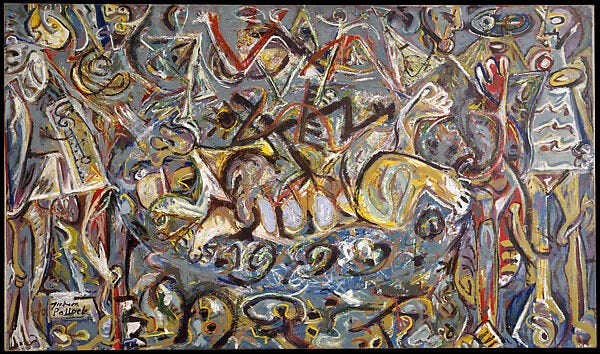
While still maintaining Pollock’s typical colorful and energetic style, you’ll note that the painting is closer to the work of Miró or Picasso than it is to his signature ‘drip’ technique developed later in his career. In the early 1940s, Pollock’s work still “played on the borderline between the recognizable and the obscure, between representation and abstraction,” per biographers Steven Naifeh and Gregory White Smith, who add that “no paintings reveal his dilemma more clearly” than this one and two others done in the same twelve-month period.
After “Search for a Symbol” and “Guardians of the Secret,” what was originally called “Moby Dick” (or possibly “White Whale” per other sources) was Pollock’s third composition featuring what Naifeh and Smith distinguish as a group of figures placed around a table. This final attempt, they write, was “a painting of furious, exploded imagery” done on what was the largest canvas of his career to date.

By the end of the year, he had returned to the same subject a third time. On the largest canvas of his career so far, an arena almost five by eight feet, he wrestled again with his conflicting needs for revelation and for concealment. The result is a painting of furious, exploded imagery, filled with figures caught between two worlds, figures that jerk in and out of reality—a limb here, an eye, a face, a hand, a penis, a pair of haunches—but relate to each other only as line, shape, and color. Unlike Guardians, nothing is left unjumbled by abstraction. The table is still there, a faint blue oval this time, and figures hover around it—one on the left, three on the right, perhaps more in the background. Unlike She-Wolf, here Jackson hasn't made a last-minute effort to sharpen the primary figures by filling in the background or highlighting their outlines. Background and figures and calligraphy vie fiercely for attention. In the confusion, Jackson dares to lift the veil on the central figure that remained hidden in Guardians, but only enough to reveal tantalizing fragments. In the center of the table, an animal of some sort lies on its back, its hind legs pumping the air. Its mouth appears to be open as if crying out. It may be disemboweled. The figures gathered around could be preparing to feast on it. Beyond that, meanings are swallowed up in abstraction—as Jackson no doubt intended.
The story of how the painting shed its original name is well-documented (or at least often-repeated) in Pollock biographies. As retold by Deborah Solomon, the story goes that James Johnson Sweeney, director of the Solomon R. Guggenheim Museum, stopped by Pollock’s studio one day in 1943 and was struck by the painting — but wasn’t such a fan of its title.
One day he was sitting in his studio with a newly completed work when James Johnson Sweeney stopped by to visit. Sweeney was still standing in the doorway when the painting caught his eye. Four totemic figures flank a central oval. Inside the oval a stick figure battles a beast. As Sweeney studied the painting Pollock told him, “That’s Moby Dick.”
“Pasiphaë,” Sweeney shouted out across the studio, ignoring Pollock’s comment. “That’s Pasiphaë.”
“Who the hell is Pasiphaé?” Pollock asked. Sweeney told Pollock about Pasiphaé, wife of King Minos, mother of the Minotaur by her intercourse with a bull.
“What’s wrong with Moby Dick?” Pollock asked.
“It’s a cliché,” Sweeney said.
Pollock gave in and named the painting Pasiphaé.
Other versions of the story suggest it was Peggy Guggenheim, a pivotal figure in Pollock’s early career, who disliked the title. As the founder of the influential Art of This Century gallery, Guggenheim provided Pollock with several enormously important opportunities for exposire, including his first solo show in November 1943 and a private commission for an mural to decorate her New York City townhouse that same year. That Pollock became a household name has much to do with Guggenheim’s eye and her almost Melvillean mission to elevate American modernist painters to the level of their European cubist and surrealist peers.
In all versions of the story, though, it’s Sweeney who suggests the title “Pasiphaë,” explaining to Pollock that she was the daughter of the sun god, Helios, and was cursed by Poseidon to lust after a “snow-white” bull. Their child was one of the more hideous monsters in Greek mythology: the Minotaur. Pollock, who was deeply versed in Jungian analysis after years of study and therapy, apparently found the story “very interesting because it… dealt with a combination of eros and bestiality.”
But the reason the story of is retold in every Pollock biography isn’t for what it reveals about his interest in Moby-Dick or Greek mythology. Rather, to many scholars it’s the prime example of how little Pollock cared about titles. Solomon, for example, writes that Pollock “never titled a painting until he was done with it,” and that it was common for his wife Lee (the artist Lee Krasner) or his friends to suggest titles. Naifeh and Smith similarly emphasize that “Pasiphaë” is, “like so many of Jackson's titles, a late graft,” something attached to the work only after it was complete.
Was this whole investigation, then, just chasing spirit-spouts? Could it be that Pollock simply began painting on a giant, white canvas and made the joke to himself that it was ‘Moby Dick’?
Buoying my hopes to find a meaningful Melville connection is that not all art historians are convinced of Pollock’s indifference to titles. Biographer Ellen Landau, for instance, locates a connection not only between the two titles and the painitng but between the two titles themselves, maybe signaling that Pollock had something in mind which fit both ideas.
Interestingly, Melville’s story of Moby Dick is not totally unrelated to the myth of Pasiphaë; in both, a human being becomes possessed by thoughts of an animal. Lust and ambition, two preoccupations of the libido, are tangled elements in both the ancient story and Melville’s great American novel, published in 1851. However, unlike the Queen of Crete, who really was a victim, Melville’s Captain Ahab (despite the conflicts in his personality) more closely follows the archetype of the hero engaged in an agon, or epic conflict. Some art historians believe that, because of his years of Jungian analysis, Pollock may have been able to associate Ahab’s search for the great white whale with what Jung called the Nekyia, or night sea journey. This term from Homer’s Odyssey was borrowed by Jung to describe the descent into, or harrowing of, the unconscious which must be undertaken by any individual who wishes to achieve a complete personality integration.
Approaching the painting from a more familiar corner of academia is Melville art scholar Elizabeth Schultz, who writes in Unpainted to the Last: Moby-Dick and Twentieth-Century American Art that the two titles “tease viewers into identifying a relationship between the cosmic visions of the writer and the artist.”
Several of Pollock's critics point out the similarities between the Greek myth and Melville's narrative, however. Elizabeth Frank notes that common to the story of Pasiphae and the white bull Poseidon and to the story of Ahab and the white whale Moby Dick are "themes of power and sexuality, of angry kings and monsters that devour and destroy"; and Barbara Rose observes that "Pollock was intent on giving a general feeling about the immense power of the forces of nature which had previously been symbolized by such mythic beasts as the Minotaur [the hideous offspring of Pasiphaë and Poseidon] and Moby Dick." […]
According to Firestone, "He would not have failed to see Ahab's voyage as a profoundly archetypal quest and Moby-Dick as a deeply primordial symbol." On his immense (56⅛" x 96") canvas for Pasiphaë, Pollock appears to tackle a theme as large as Ishmael's: to grasp in paint what Ishmael seeks to grasp in words, "the image of the ungraspable phantom of life." […]
As Melville attempts in the course of his novel to give verbal form to the fluid, protean, enigmatic process of life, so does Pollock in Pasiphaë attempt to give this life visual form. Dominating the center of the painting is a massive elongated, segmented figure in a fury; its appendages flailing, it seems to be gyrating, like the squid, spewing forth elements from its maelstrom. Both horror and wonder, the figure cannot be comprehended; it can only be represented and, thereby, contained within the confines of the picture. Emphasizing its confinement within his frame, Pollock sets as guards for the figure two skeletal, totemic forms, one on either side, and writhing, tortured lines and disembodied organic shapes, top and bottom. Thus Pollock's central figure becomes like the great white whale itself when it erupts at last from the sea and into the final chapters of Melville's novel: deceptively passive, "a mighty mildness of repose in swiftness.” Focusing not on the radiant beauty of Ishmael's vision of Moby Dick, Pollock objectifies in this figure chaos, power, energy unpredictable, uncontrollable, unknowable. Thus Pollock's guardian figures may be said to swing open "the great flood-gates of the wonderworld" and to usher the viewer into the depths of the painting's "inmost soul," where Pollock reveals, he says, "the source of my painting.... the unconscious." With Pasiphaë Pollock fulfilled his own dictate for "the modern artist, [who] it seems to me, is working and expressing an inner world-in other words-expressing the energy, the motion, and other inner forces."
To reiterate from previous posts, I’m a researcher, not an art historian. I’m just here to present some findings and you all can decide how convincing any of this is. Meanwhile, I was still looking for some cold, hard facts and, with that, let’s move onto Pollock’s next encounter with the white whale.
“Blue (Moby Dick)”
The same year he painted the large-scale “Pasiphaë,” Pollock was also working on a mixed medium piece using gouache and ink on a much smaller composition board, measuring just 18 3/4 by 23 7/8 inches. This time the name stuck, still known today as “Blue (Moby Dick).”
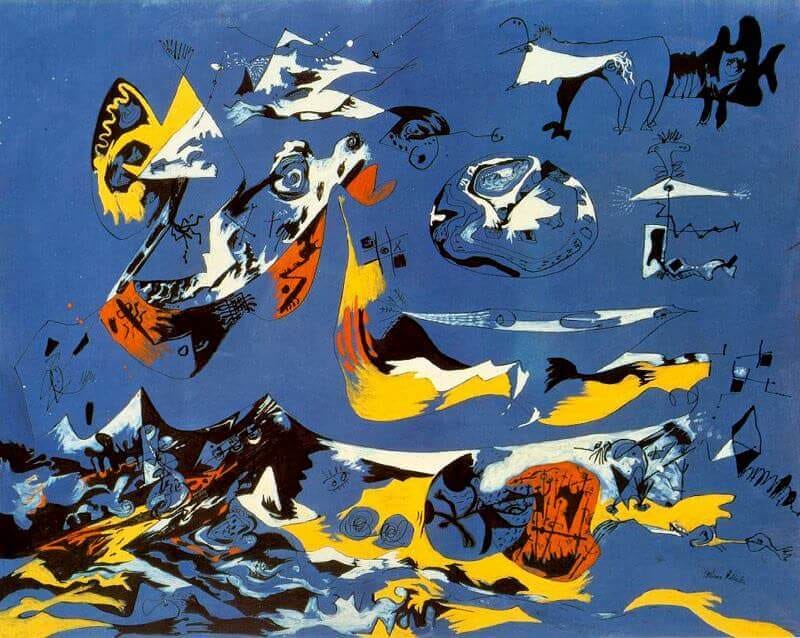
At least to my eye, “Blue” certainly looks like to be far more influenced by the colors, shapes, and mood of Moby-Dick. In 2019, the Boston Globe wrote that it "might be interpreted as the shattered aftermath" of book. Although it’s arguably even more abstract than “Pasiphaë,” it’s no great leap to perceive tumultuous waves at the bottom, pyramidical white humps, and what might be sails, birds, or fish.
A description of the painting from Artchive.com supports this interpretation, noting that despite being part of the abstract movement, the work “is recognized as having figurative elements.”
Describing the artwork, one observes a vivid display of blue that dominates the composition, providing a backdrop for the swirling, dynamic interplay of forms and colors. Pollock’s use of a contrasting palette, featuring bold yellows and touches of black and white, enhances the sense of movement and energy throughout the piece. The forms are evocative rather than representational, inviting viewers to interpret the chaotic and fragmented motifs that suggest marine life forms and nautical themes, in line with the title’s reference to Herman Melville’s epic tale, “Moby Dick.” This work captures the essence of Pollock’s innovative approach during a transformative period in his artistic career.
The Melvillean analysis from Schultz focuses on the chaos and landlessness of the scene, connecting the imagery to Pip, Bulkington, the riddle of Queequeg’s tattoos, and the “boggy, soggy, squitchy picture” at the Spouter-Inn.
Whereas Pasiphaë is an exploration of a dark unconsciousness, (Blue (Moby Dick)) explores the bright cosmos. Here a hard, brilliant blue background, against which Pollock draws, extends space beyond the boundaries of the frame. Long, sweeping, even languid lines in the lower part of the painting reinforce the eye's movement outward. Space in (Blue (Moby Dick)) seems unconstricted and chaos unconfined. Yet the representation of a ceaselessly leaping sea, created by jagged upward thrusting lines of black and white, with multishaped and multicolored forms tangled in its trough and spun free into the blue above, turns the eye back into the painting. These Miro-like forms, geometric and organic, realistic and fantastical, are at once concentrated, knotted in upon themselves and trembling in isolation, and sprawling, spawning, and generating new forms; they suggest divine playfulness, ceaseless mutability, infinite possibility. They resemble the vision that Pip, the Pequod’s Cabin boy, beheld when, abandoned in the middle of "the heartless immensity" of the sea… […]
For Pollock the acceptance of freedom, the striving for fluidity, is and has been the supreme discipline." Thus (Blue (Moby Dick)) might be considered a projection of the inner sea of the mind and of Pollock's awareness of the necessary risks involved in intellectual and psychological freedom. Its evocation of an infinity of blue space and of an infinity of forms affirms his consciousness of Bulkington's conviction that "in landlessness alone resides the highest truth.”
Again, I’ll leave it to you as to how compelling you find this interpretation or whether you believe Pollock had any of this in mind while painting. But there’s an even more fundamental question we have to answer first: did Pollock even read Moby-Dick?
“Not much of a reader”
For all the analysis connecting Pollock’s shapes and brushstrokes to specific themes of the book, there’s compelling testimony from those who knew him that the connection to Moby-Dick was tenuous at best. In fact, most biographers agree he was generally “not much of a reader,” and there may be a hint in just how few of his paintings and drawings allude to books. Aside from “Blue (Moby Dick),” there are just two other references in the his entire catalog according to Schultz, to The Tempest and Don Quixote.
Among the doubters is author and art critic B.H. Friedman, whose 1972 volume Jackson Pollock: Energy Made Visible is considered the first major biography of the artist. Friedman was also a friend of Pollock’s and his wife and got intimate glimpses of their home life, routines, and artistic practices, noting they led focused and often solitary lives in their home in East Hampton. “Neither was a great reader,” he remarks, taking in books and magazines with more of an visual eye for inspiration than with serious appreciation for their literary value.
Some nights they read, but critics have made too much of this, as if offering credentials for the Pollocks’ culture. Neither was a great reader. The East Hampton Star, the Sunday Times, popular and art magazines (frequently given to them by friends weeks or months after publication) —these were more than enough to read; and even with these the reading was exceptionally physical, a matter of turning pages, recording images, tracing them with the hands, as one “reads” art books.
He concedes that Krasner had once read some 19th century Russian classics, and perhaps Pollock had long ago read Moby-Dick, “but neither Lee nor Jackson remembered these books in detail; they had rather felt their spirit and absorbed the books in that more general way.”
Friedman dismissed the couple’s reading habits again in an interview for the Naifeh and Smith biography, getting right to the point of this very blog post: “I doubt that he ever read more than just bits of Moby-Dick.” In fact, he was remarkably consistent on this point, telling a detailed story to Jeffrey Potter for his oral biography of Pollock.
B.H. FRIEDMAN: One evening when we were walking the ocean beach I had to unwind. I plunged in and Jackson, saying something to the effect of "If you can, I can," followed. There was quite a strong undertow and I saw him being beaten by the waves. I thought he might drown. I don't think he could dive breakers—his splashing was more like a dog swimming, with a lot of thrashing around. I got out as fast as I could. Which meant he had permission to get out, you know?
The beach was a place he loved, and I remember his staring at the formations of the water—you know, the way it would soak into the sand. And I remember him letting the sand run through his fingers, and of his loving the landscape there. I asked if Melville didn't mean a lot to him because of Ahab and the Moby Dick interest. I suspected he had never read it—that it was something that had been assigned and he talked about after maybe reading a little bit. If Jackson had been on a talk show such as we have today, Cavett saying, "What are your favorite books?" Jackson might say Moby Dick. But I don't really know how much it meant to him.
So maybe he didn’t read it, or he read it but it didn’t mean much to him, or just read parts. Friedman is actually somewhat inconsistent on this point. He does, however, hint at one unresolved issue for the doubters: when Friedman says he asked if the book meant a lot to him “because of Ahab,” he’s not referring to the captain of the Pequod. He’s referring to Pollock’s dog, a black poodle named Ahab.
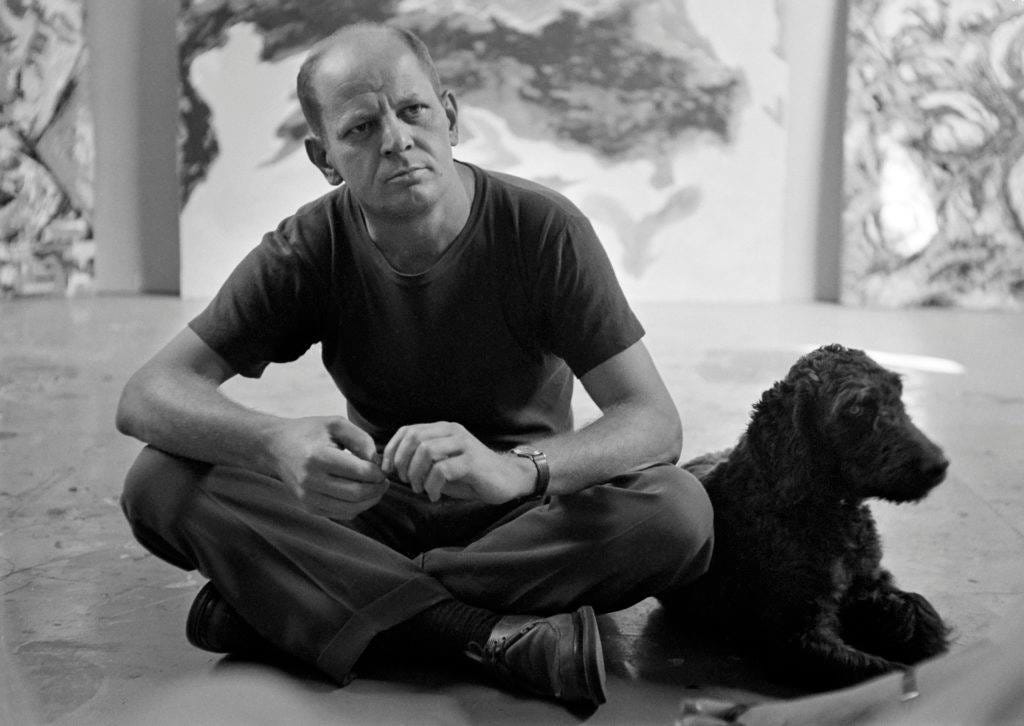
If I’ve said it once, I’ve said it a dozen times: when someone names their pet, their coffee shop, their restaurant, their yacht, their sculpture, or their experimental rocket after Moby-Dick, it’s worth taking note of that decision. (As I’ve mentioned before, my own three-legged cat is named Captain). Surely all this is not without meaning.
Take, for instance, a letter from Pollock to his brother when he was a student at Manual Arts High School in Los Angeles, saying that he was electively taking both American Literature and Contemporary Literature in addition to his art classes. Littered throughout his family’s correspondence also are frequent references to magazines, plays, and items from The Literary Digest. The Pollock family, write Naifeh and Smith, “were deeply immersed in the culture of their time.”
More to the point, Naifeh and Smith cite artist Peter Busa who recalled that Pollock “laid siege” to Moby-Dick after his father died in 1933. Pollock, then 21 years old, allegedly read it over and over as 21 year olds are wont to do.
Peter Busa recalls that Jackson's obsession with his father's death had led him to questions about "fate" and "chance" and "what he had done to deserve it all." Someone—Richard Davis, perhaps—had given him a copy of Moby-Dick, and Jackson had laid siege to it repeatedly—"he must have tried to read it not once but ten times," Busa recalls—perhaps identifying with Captain Ahab's obsessive search for meaning in the seeming arbitrariness of life.
Bryan Robertson, writing just four years after Pollock’s untimely death (look it up, it’s not good) recorded that Moby-Dick was one of just a few books he left behind in his studio along with Joyce’s Ulysses and d’Arcy Thompson’s On Growth and Form, and was one which he read “many times with special feeling.” Ellen Landau also supports the idea that he might have been genuinely interested in Moby-Dick, even if it was simply picked up through conversations with friends.
Once more, there is a good chance that William Baziotes may have exerted some influence on Pollock’s interests; according to his wife and a number of other friends, Bill was extremely fond of Melville’s most famous book. Many remember that he loved to quote one of Ishmael’s early lines in Moby Dick about “‘a damp drizzly November in my soul.” […] He certainly appears to have somehow absorbed the general theme of Moby Dick, perhaps from high school English, or through the interest in Melville of Krasner and others around him (a kind of “fad” for Melville was at its peak in the early forties). The summer after he painted Pasiphaé, Pollock and Krasner may have attended some of the sessions in Provincetown when Joe Hazen (a friend of Tennessee Williams) read passages from Moby Dick aloud by lamplight."
There are even those who believe that Pollock’s 1945 painting “Portrait of HM” could be in reference to Herman Melville. That said, the entirely abstract expressionist painting is certainly not a portrait in any traditional sense so there are no clues there, and the title may just as easily refer to either of his friends Helen Marot or Herbert Matter.
Even the skeptics would have to agree with Schultz, who points to the Melville milieu that had taken over the country by the early 1940s, including film, TV, and radio adaptations, celebrated illustrated editions, and so on. Several of Pollocks artist friends were fans of the book and used it as inspiration for their own paintings. Or maybe he encountered it in his years of Jungian psychotherapy. Jung, after all, wrote in 1930 that he considered Moby-Dick to be “the greatest American novel” and one which “offers the richest opportunities for psychological elucidation.”
In other words, it would have been difficult to hide from Moby-Dick in the mid-20th century, ubiquitous even in the therapist’s chair. To have any interest in popular culture at the time almost guarantees that Pollock would have had at least a passing familiarity with the book.
Blue Notes & Records
I was personally feeling convinced that Friedman and the doubters had to be wrong. Even if he didn’t know the book by heart, there seemed to be ample evidence that he was familiar with the plot, the themes, and who knows, maybe he’d even seen the two Moby-Dick film adaptations or caught the traveling exhibition of Rockwell Kent’s illustrations.
Then came another curveball and everything I thought I knew about the painting started to fall apart. I actually reached out to biographer Ellen Landau in hopes she might be able to help figure out a few lingering questions about the history and provenance of the painting. She responded right away with information straight from the four-volume catalogue raisonné published in 1978 — one work I hadn’t been able to get my hands on. Still considered the definitive catalog of Pollock’s body of work, Landau wrote back that it lists the painting as being first shown publicly under the name “Blue (Moby Dick)” at the Museum of Modern Art in 1967. By the time the catalogue raisonné was published it had been sold by the Robert Elkon Gallery to a private collector in Japan, who had in turn donated or sold it to the Ohara Museum in Kurashiki, Japan.
I raised an eyebrow. Not known to be named until eleven years after his death? Landau herself had written in her biography that it’s “not even known whether Pollock himself assigned the gouache’s title.” I’d been hoping to find evidence to the contrary, but despite everything I’d put together I saw nothing to suggest it ever had a name while Pollock was alive.
Then, when I found a copy of the exhibition catalog from 1967, the painting was listed as having been done in 1946, not 1943. A decade later it was moved back three years with no explanation why. So not only was the title in question but so was the date.
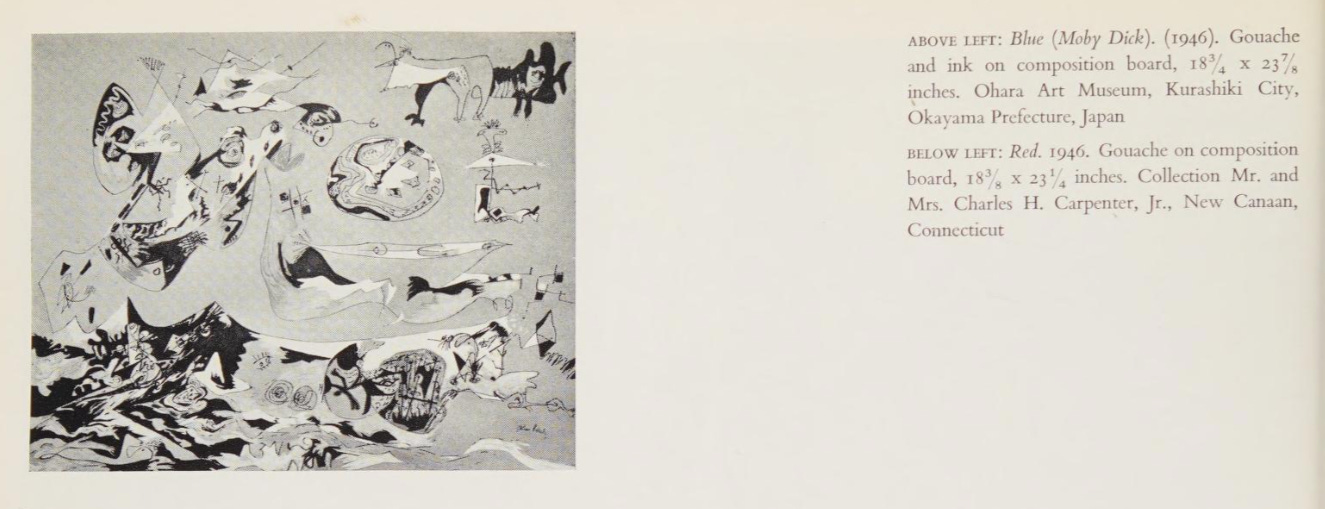
In other words, just about everything said about “Blue (Moby Dick)” might be mistakenly based on the questionable assumption that Pollock gave it its title. Yet, it’s not an entirely unreasonable theory that the painting was left untitled by Pollock during his lifetime and that Krasner later made a connection between the colors and themes and simply decided to reuse a title he’d once considered but discarded.
As I said at the beginning, the investigation ultimately looped back on itself and left me less sure of nearly everything I had set out to find. Pollock created a painting in either 1943 or 1946. He may have named it “Blue (Moby Dick)” but it’s just as likely he did not. He may had read Moby-Dick but he might not have, or maybe he skimmed it, but experts disagree on whether it meant anything to him.
At least we can just appreciate the painting with a newfound understanding of his interests, methods, and development of his techniques, right?
Sure, but you can’t do it in person. If you’d like to see “Blue (Moby Dick)” up close, you’re out of luck. The painting wasn’t mentioned anywhere on the website of the Ohara Museum of Art, so I contacted the museum to confirm whether they still had it nearly 50 years later. It’s still there, a representative told me, but “not currently on display.” Preempting my needling follow-up question, they added: “We do not know if it will be displayed in the future.” Double-bolted Japan, indeed!
For what it’s worth, “Pasiphaë” is also “not on view” at the Met Museum.
The Upside-Down
If we can’t close on a positive note, I offer at least a ridiculous one.
One place you can spot the painting, or at least a replica of it, is in the 2000 film Pollock directed by and starring Ed Harris. The painting appears in a scene set at the opening of his solo show in November 1943 which I’m now able to pedantically point out is historically inaccurate. Neither Pasiphaë” not “Blue (Moby Dick)” were completed in time for the show at Peggy Guggenheim’s gallery.
But while I can suspend disbelief regarding small issues of anachronistic set decoration, the film nevertheless falls headfirst into the cliché of clichés of modern art: the painting is displayed upside-down!
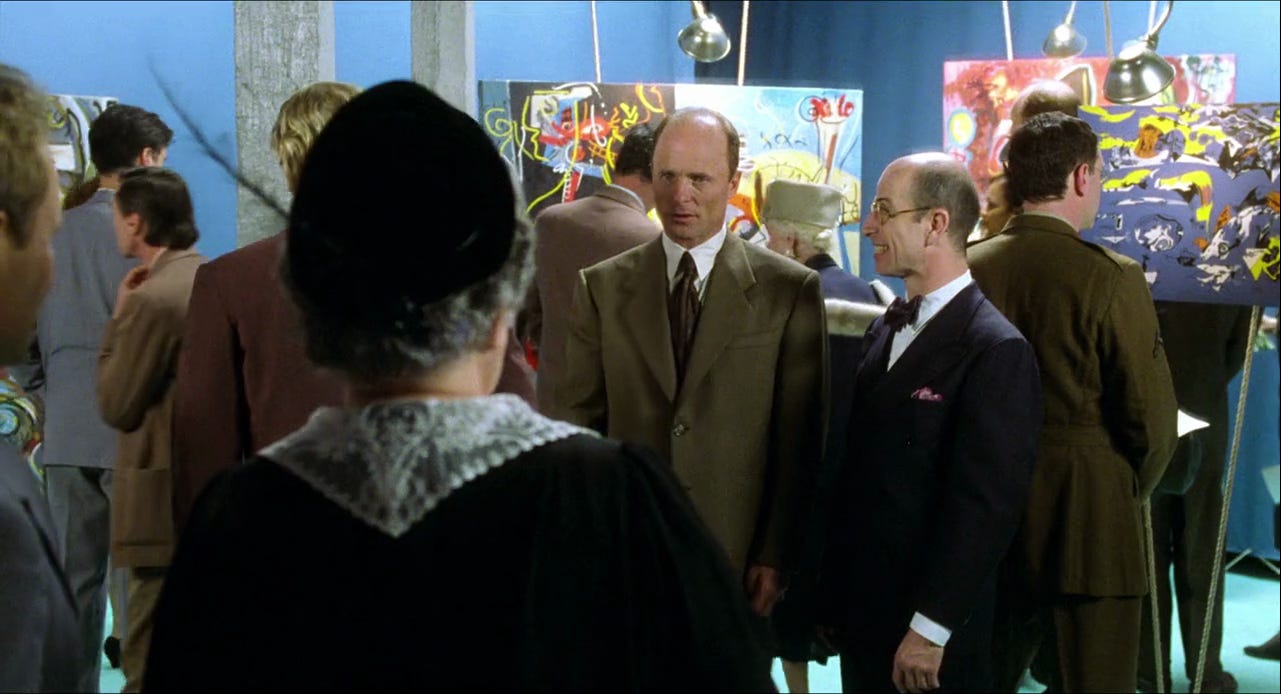
To be sure, someone evidently noticed the error and just a few moments later in that scene it’s turned right-side up.
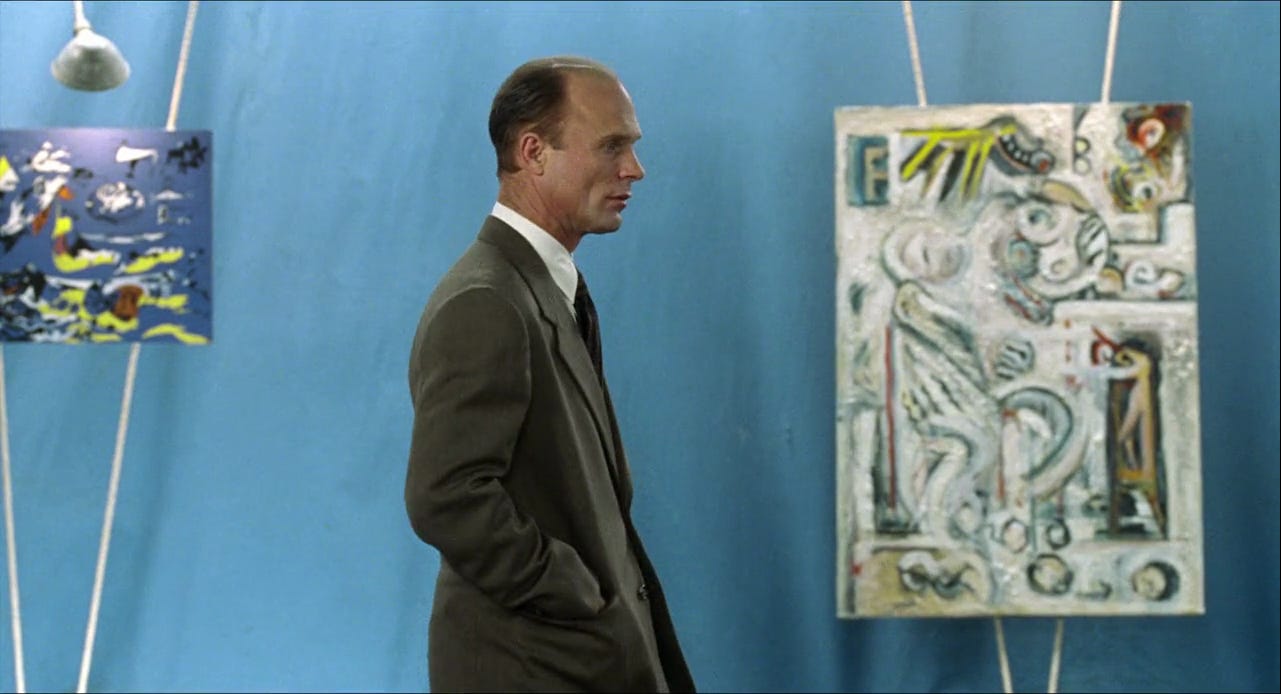
What better ending to this topsy-turvy investigation?
Thanks & References
Thank you to Ellen Landau for her invaluable help figuring out the provenance of the painting, as well as the Ohara Art Museum and the Elkon Gallery.
“Blue (Moby Dick) (c. 1943) by Jackson Pollock,” Artchive.com
B.H. Friedman, Jackson Pollock: Energy Made Visible (1972)
Chiara Ianeselli, “The Untitled Title in 20th Century Art: Revolutionary Aspects
and Implications,” 2021
Ellen Landau, Jackson Pollock (1989)
Steven Naifeh & Gregory White Smith, Jackson Pollock: An American Saga (1989)
Sylvia Winter Pollock (ed.), American Letters, 1927-1947: Jackson Pollock & Family (2011)
Bryan Robertson, Jackson Pollock (1960)
Bernice Rose, Jackson Pollock: Works on Paper (1969)
William Rubin, “Pollock as Jungian Illustrator: The Limits of Psychological Criticism,” Art in America, 67, No. 8 (Dec. 1979)