
The Street
; or, the un-dedication of Pittsfield's Melville St.

Today I have for you all a relatively simple investigation to be filed somewhere in the unofficial “Geography of Herman Melville” series alongside the look at Liverpool’s Booble Alley, Melville’s tour of ancient Paris, and the Moby-Dick mountains and glaciers in Antarctica. This one, however, is much closer to home—Melville’s home, anyway.
As per usual, I was deep in the weeds of a completely unrelated Melville mystery, perusing late 19th century issues of the Berkshire Eagle, when something caught my eye. A stray search hit had returned an article from June 11, 1897 about the City of Pittsfield condemning an old tenement house at North and Melville streets, the latter said to have been named for Herman.
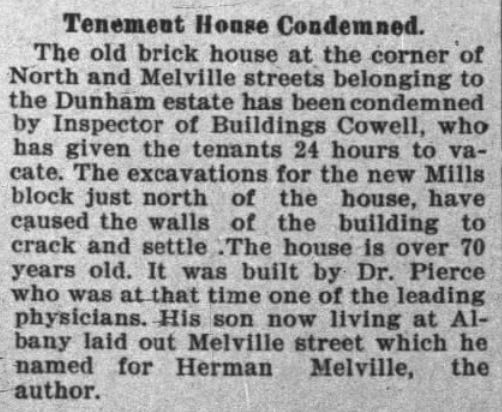
Granted I’ve only had the privilege of going to Pittsfield one time, but I was unaware that the city ever had a street named for Melville. More surprising was that it’d been named as such within a few years of his death, if not earlier.
Of course I quickly looked to see if the street still existed to this day and there it was, perpendicular to North street just as stated. The Berkshire Athenaeum, with its Herman Melville Memorial Room, was just a few blocks away.
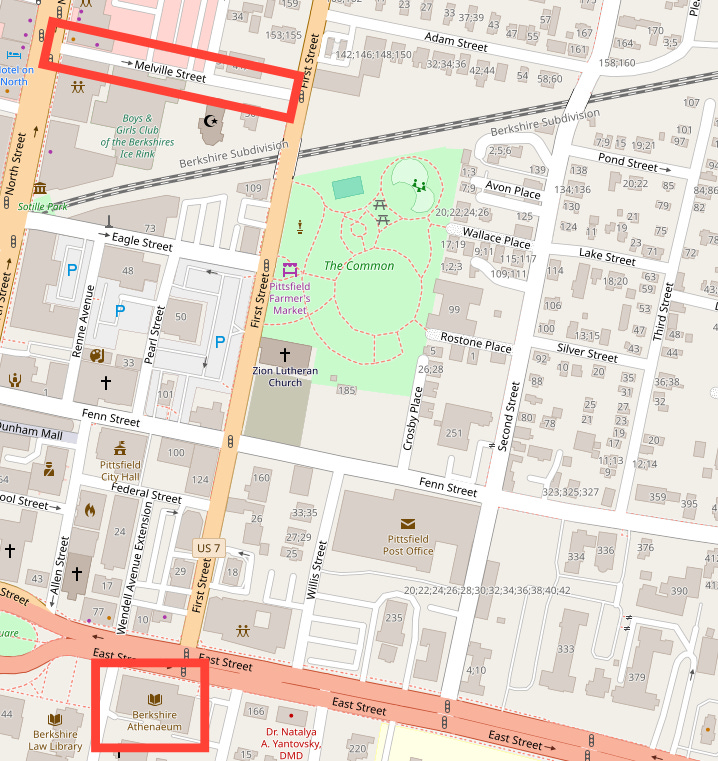
The article wasn’t clear about exactly when the street was named, just that the house itself had been at that location for “over 70 years.” With Melville having died just six years prior, it seemed plausible that the street had only recently been renamed in his honor. And if so, perhaps there were records of that decision? A mayoral proclamation? A (very short) parade down its ~700 feet in length?
“Some years ago—never mind how long precisely”
Often the best place to start this kind of research is with Sanborn Fire Insurance Maps. First produced in the 1860s to help underwriters assess their liability, the project created a block-by-block snapshot of cities across the country every five to ten years, all the way through the 1960s. These maps now serve a much broader purpose documenting urban growth over this pivotal hundred year span, and have been freely available since the Library of Congress digitized their entire collection in 2017.
Thus, finding maps of Pittsfield from the era was a straightforward task. The catch was that the first one I checked from 1889 showed that Melville Street was already there two years before Herman died.
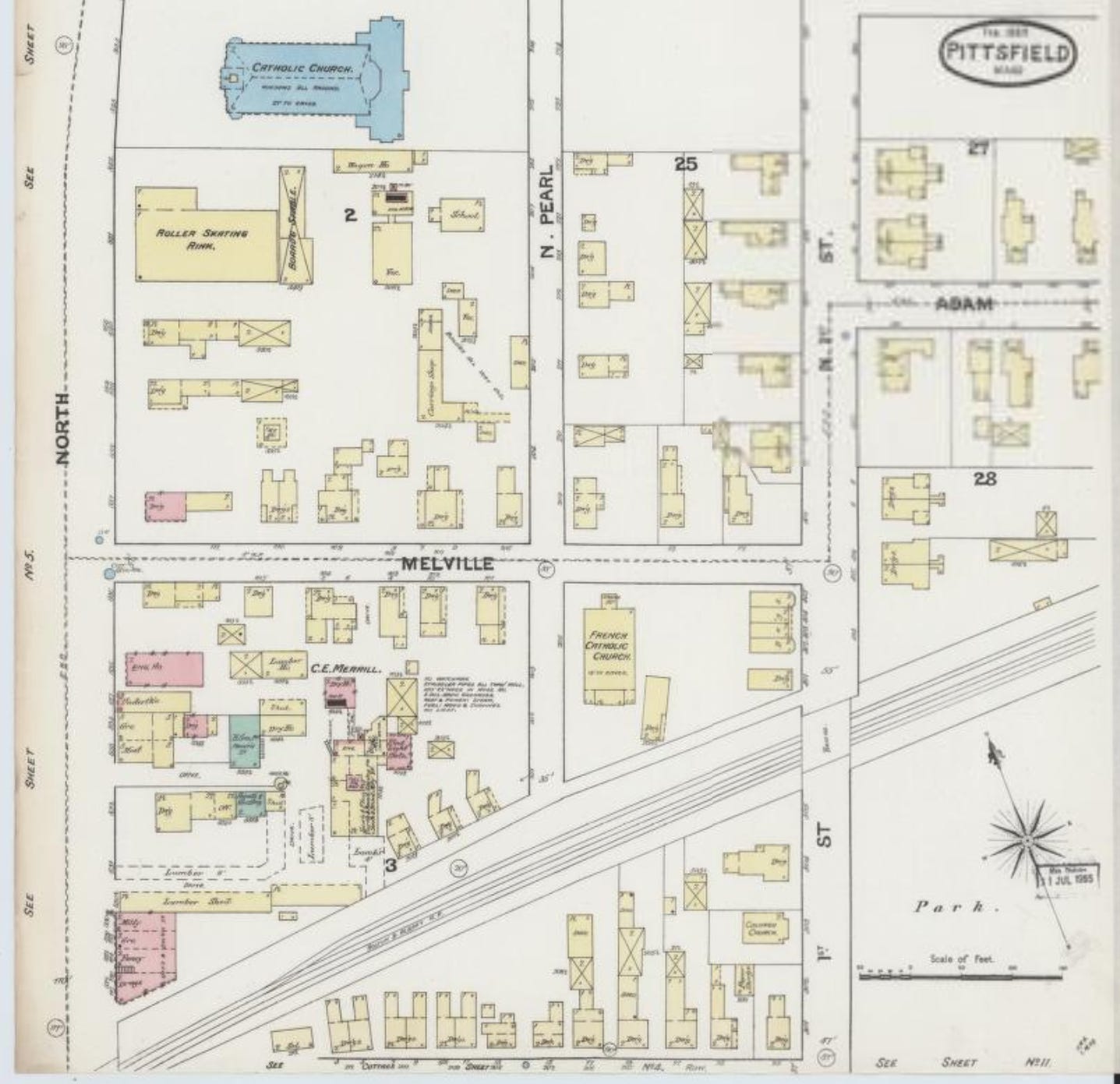
When I saw that Melville Street was also on the Sanborn map from 1884, I realized that something was off. Clearly the street wasn’t posthumously named in his memory, but it also seemed strange to name it for him in the days of his darkest obscurity in the public eye. So how far back did it go?
I found an even older map, a decorative poster from 1876, and there it was again.
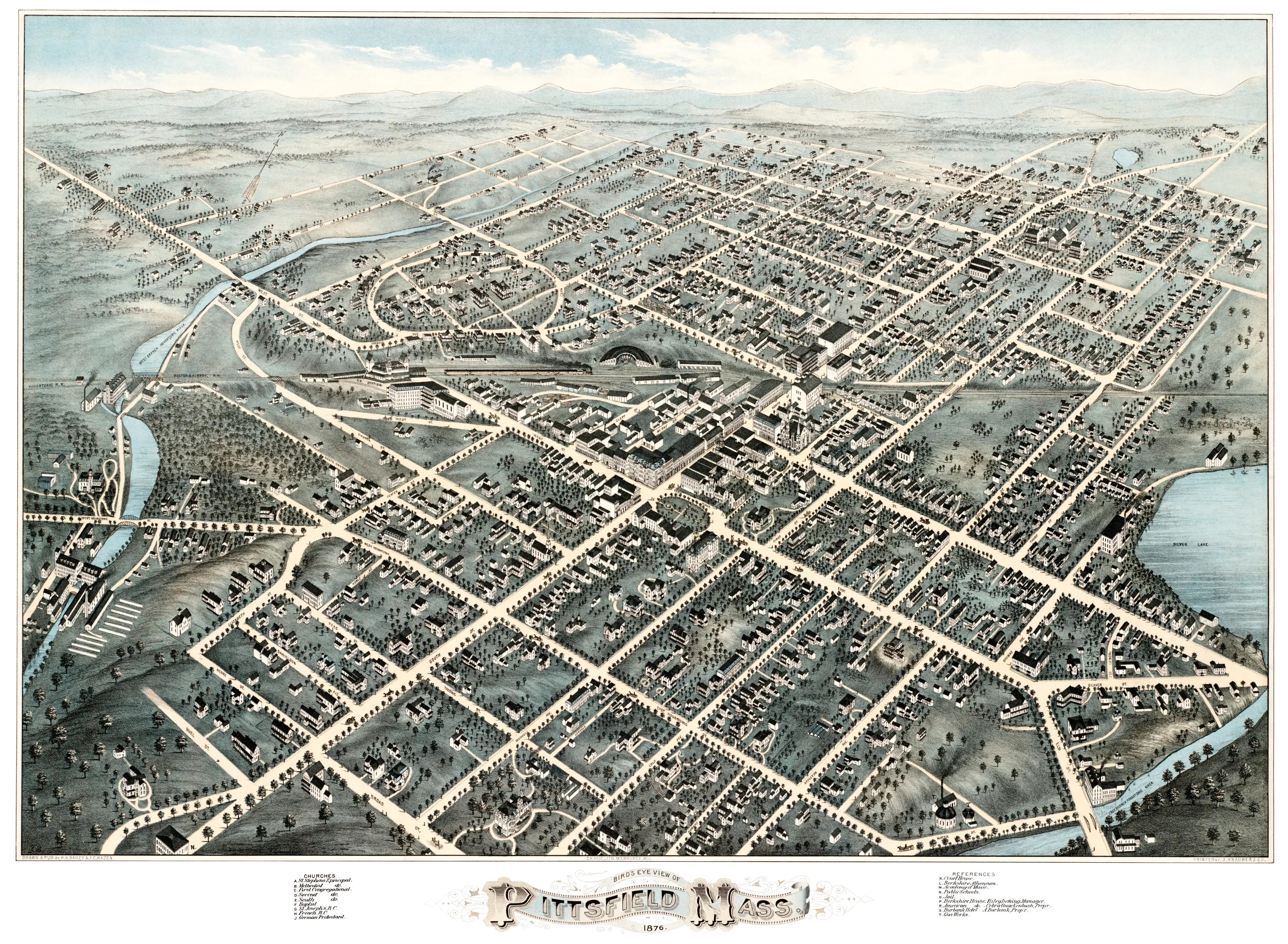
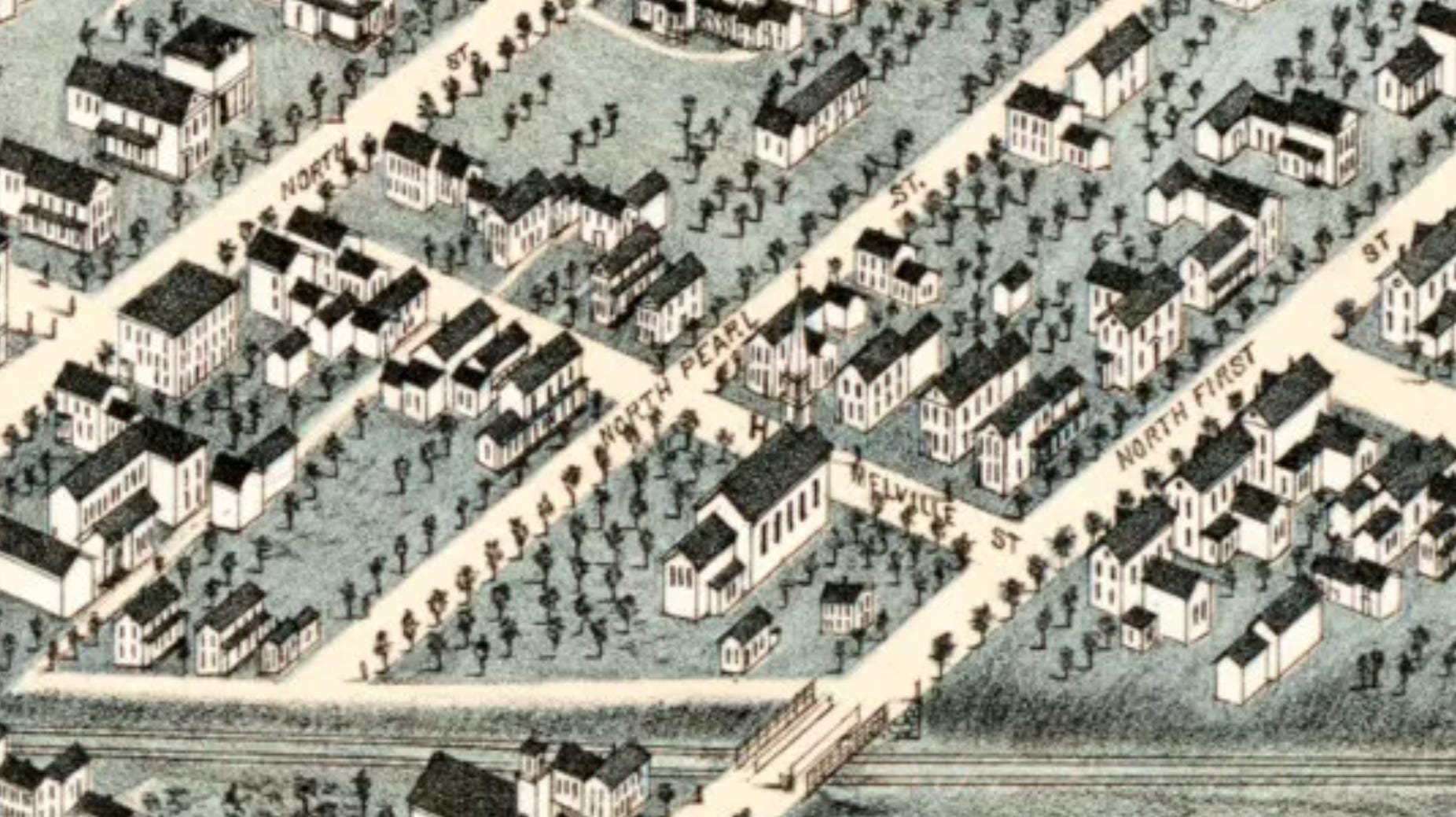
(Ignore that the street appears to be labeled “H. Melville St.” Per the legend at the bottom the map, the “H” actually labels Notre Dame Church. Its placement beside “Melville St.” was purely incidental.)

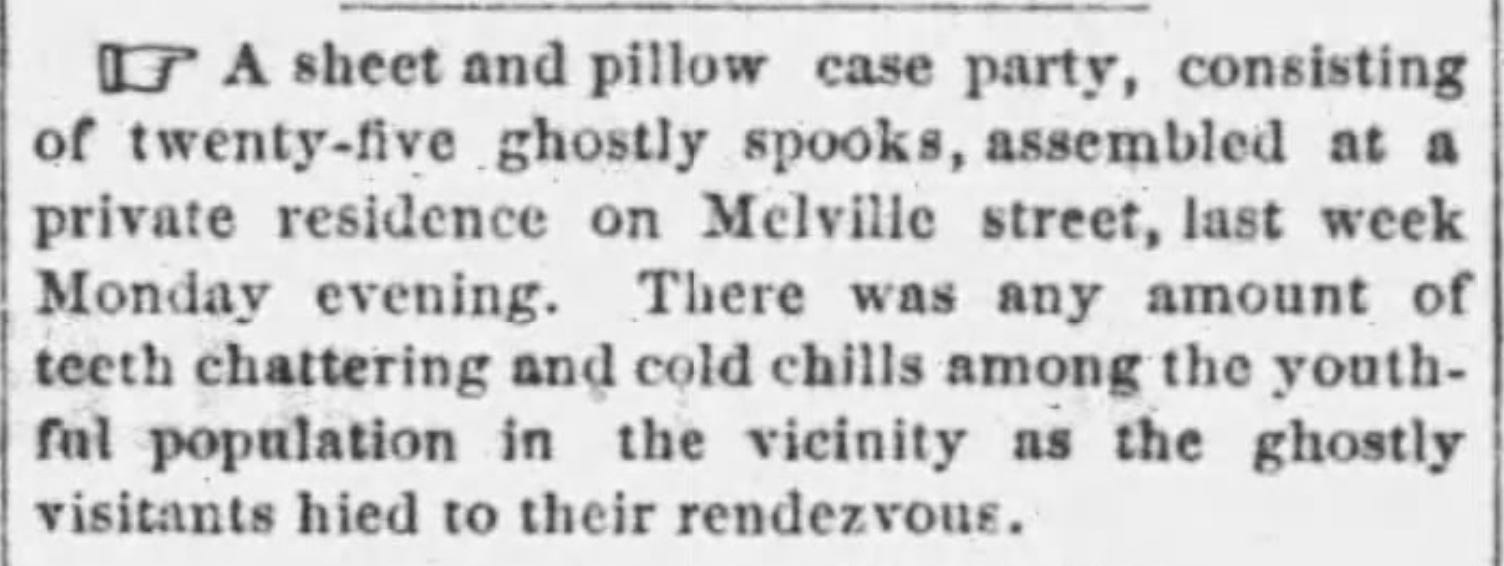
Here I ran out of old maps so I went back to digitized newspapers, and it was easy to find mentions of the address going way, way back. For instance, shortly after Halloween in 1873 the Pittsfield Sun reported on a “sheet and pillow case party” for 25 youngsters who dressed up as ghosts and convened on Melville Street.
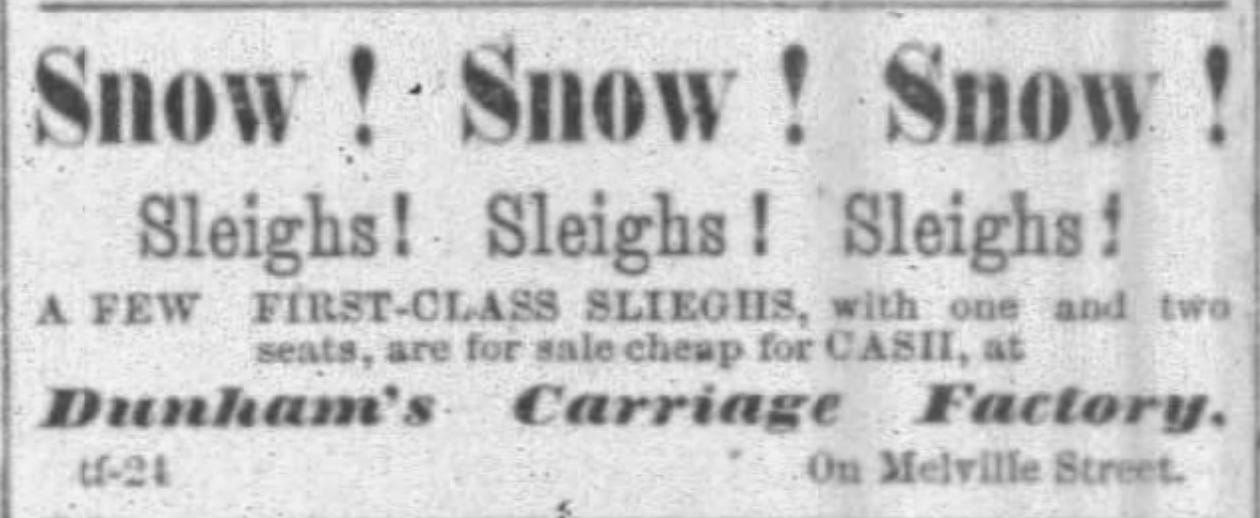
A year earlier, Dunham’s Carriage Factory was selling first-class Sleighs! Sleighs! Sleighs! to ride through the Snow! Snow! Snow!
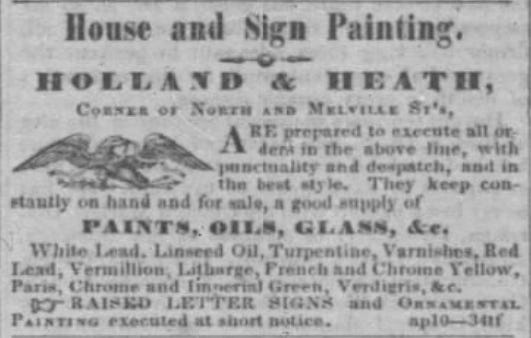
As I kept scrolling back through time it became obvious that the street had nothing to do with Herman, after all. He was still living in Pittsfield in August 1862 when a woman printed a wanted ad in the Berkshire Eagle looking for a housekeeper for her Melville Street home. But the nail in the coffin for that theory was an ad for Holland & Heath house and sign painters published in 1849, a year before Herman and his family even moved to the town.
So… who was it named for?
O Pittsfield Tom!
As anyone with a passing knowledge of Melville’s biography could tell you, the next best guess was that the street was likely named for Herman’s uncle Thomas who lived in Pittsfield for about 25 years. His presence there is what originally drew Herman to the area, spending several summers as a teenager on family visits and working on Thomas’ farm. It was during these visits that Herman fell in love with the Berkshires wandering around the mountain landscape of Western Massachusetts.
Thomas, in short, had been a successful businessman in post-Revolutionary France in the late 18th and early 19th century, “mixing commerce, banking, and low-level diplomacy” per John Bryant’s Herman Melville: A Half Known Life. He mingled with the likes of Napolean and Lafeyette and married a French wife with whom he had six children, returning to the U.S. in 1811 where he was put in charge of a prisoner-of-war camp in Pittsfield during the War of 1812. For his service he was earned the rank of Major, no doubt with the glory of his father, a hero of American Revolution, always in his mind.
His period of personal success and fortune, however, soon came to an end. Thomas’ wife François died in 1814. His father purchased an estate on a large farm just south of town and rented it to his son, but Thomas Jr. could never seem to make it financially viable, spending considerable time in debtors’ prison. He finally left Pittsfield in 1837 for Galena, Illinois, then a bustling frontier boomtown on the Mississippi River.
Another possibility for Melville Street’s namesake was Thomas’ son Robert, who managed his father’s property after Thomas left for Illinois in 1837. That summer, Robert’s listless first cousin Herman was again sent to Pittsfield to work on the farm and stayed in the area through the winter teaching at the nearby Sikes District School. But while Herman was gallivanting around the globe on whaling ships, Robert, just two years older, was continuing to establish himself in Pittsfield. In the mid-1840s, he turned the “fine old mansion” on the farm into a summer retreat for Berkshire vacationers, welcoming guests including Longfellow, Hawthorne, and Oliver Wendell Holmes.
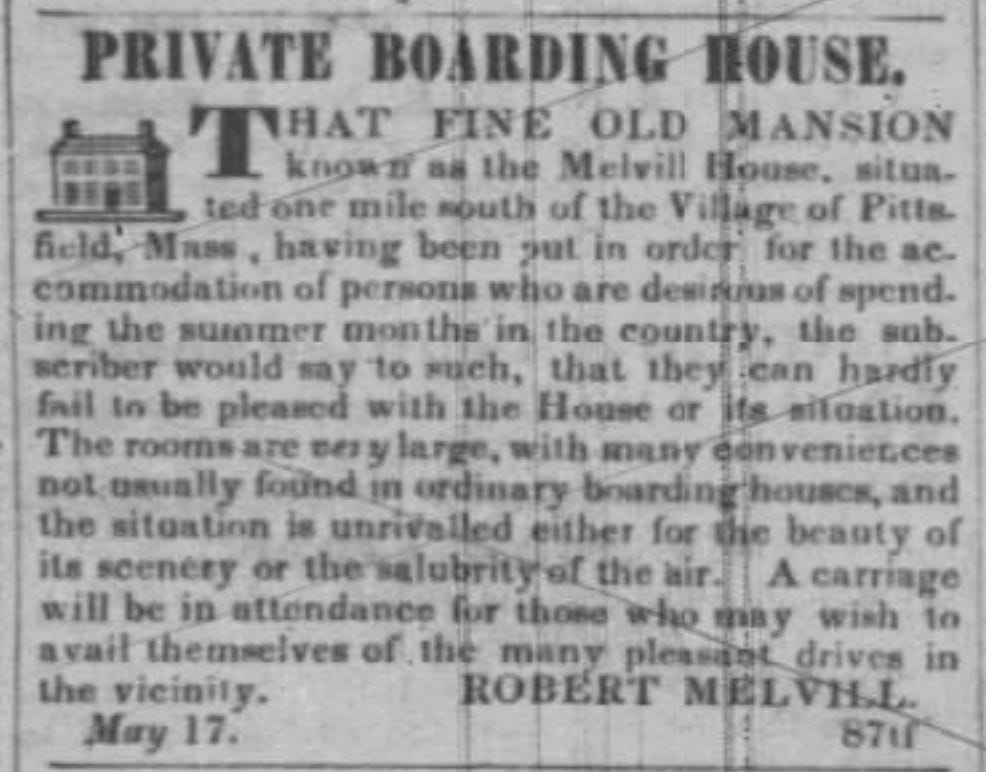
In 1850, Robert decided to join his family out west, selling the property to John Morewood and his wife Sarah. But before he left, he invited his cousin for one last family gathering in Pittsfield. It was during this extended visit that Herman met his idol Nathaniel Hawthorne on a hike up Monument Mountain, inexorably altering his vision for Moby-Dick which he’d begun writing earlier that year. As the story goes, Herman hastily arranged to buy the property directly adjacent to the Melvill (now Morewood) House, renaming it Arrowhead.
“What to Do About Melville St.”
You may have noted in Robert’s boarding house ad above, though, that there’s one small issue with the theory that the street was named for either Thomas or Robert: their family didn’t spell their surname with a final -e the way that Herman’s branch of the family did. While I found occasional references to the street spelled without the E, the very earliest starting in May 1849 all spelled it Melville Street. In fact, between 1849 and 1897, the rough tally was quite lopsided: 3,200 hits on Newspapers.com with the E compared to 80 without.
I also discovered that I wasn’t the only person to look into this mystery. In February 1980, the Berkshire Eagle ran an article headlined “What to Do About Melville St. Remains Topic of Lively Debate,” highlighting the daily congestion caused by half a dozen afterschool programs that emptied out onto Melville Street which, they erroneously noted, was “named after the author of “Moby-Dick.”
A few days later the paper had to issue a correction (no doubt in response to a pesky fact-checking like myself), adding their “best guess” for its namesake was Herman’s uncle.
While it’s true enough that Melville Street’s congestion problems are of whale-sized proportions, our reverence for Moby-Dick shouldn’t have cause us to jump to the conclusion that the street was named after Herman Melville, as stated in Tuesday’s paper.
That fact is that Melville Street was an established thoroughfare back in the early decades of the 19th century before “Moby-Dick” was a glint in Herman’s eye, if that. The best guess is that it was named after his uncle, Major Thomas Melville, an illustrious citizen in his own right who for many years farmed the land now occupied by the County Club of Pittsfield.
Anthony G. King, executive director of the Berkshire County Historical Society headquartered at Arrowhead, must have caught wind of the confusion. The organization had only recently acquired and restored Melville’s house a few years earlier and had been giving lectures about his time in Pittsfield. But when a reporter from the North Adams Transcript attended a lecture in February 1981, King credited the wrong Thomas, pointing instead at his father (i.e., Herman’s grandfather), Major Thomas Melvill.
Melville’s ties to the county began in his youth, when he would visit “Broadhall,” his uncle’s estate in Pittsfield. The building is home now to the Pittsfield Country Club on the Pittsfield-Lenox Road.
The grandfather, Thomas Melvill, incidentally spelled his surname without the final “e,” but Melville’s mother added it to distinguish herself and family from her husband Allan, who died a business failure. Thomas Melvill played an active role in the American Revolutionary period—and Melville Street in Pittsfield is named and misspelled after the Boston merchant, not the Berkshire writer, Mr. King said.
The confusion is understandable. Thomas Jr. had a minor role in the War of 1812 and mostly made a name for himself in Pittsfield as president of the Berkshire Agricultural Society (despite his own poor farming). Thomas Sr., though, was present at the Boston Tea Party and shot cannons at British ships in Boston Harbor. Yet, his own connection to Pittsfield was marginal outside of buying property for his struggling son.
Since local papers and Berkshire leaders only seemed to confuse the issue even further, it was time to answer this question once and for all.
Berkshire Marble
… and by “time to answer this question,” what I mean is that I asked David Laczak, a local history expert at the Berkshire Athenaeum and an invaluable reference for this blog on several occasions. (See “Billy Budd in the Breadbox” and “Images of Melville, Part 1”). It took David no time at all to dig up minutes for the town meeting which considered the question of Melville Street on April 3, 1848.
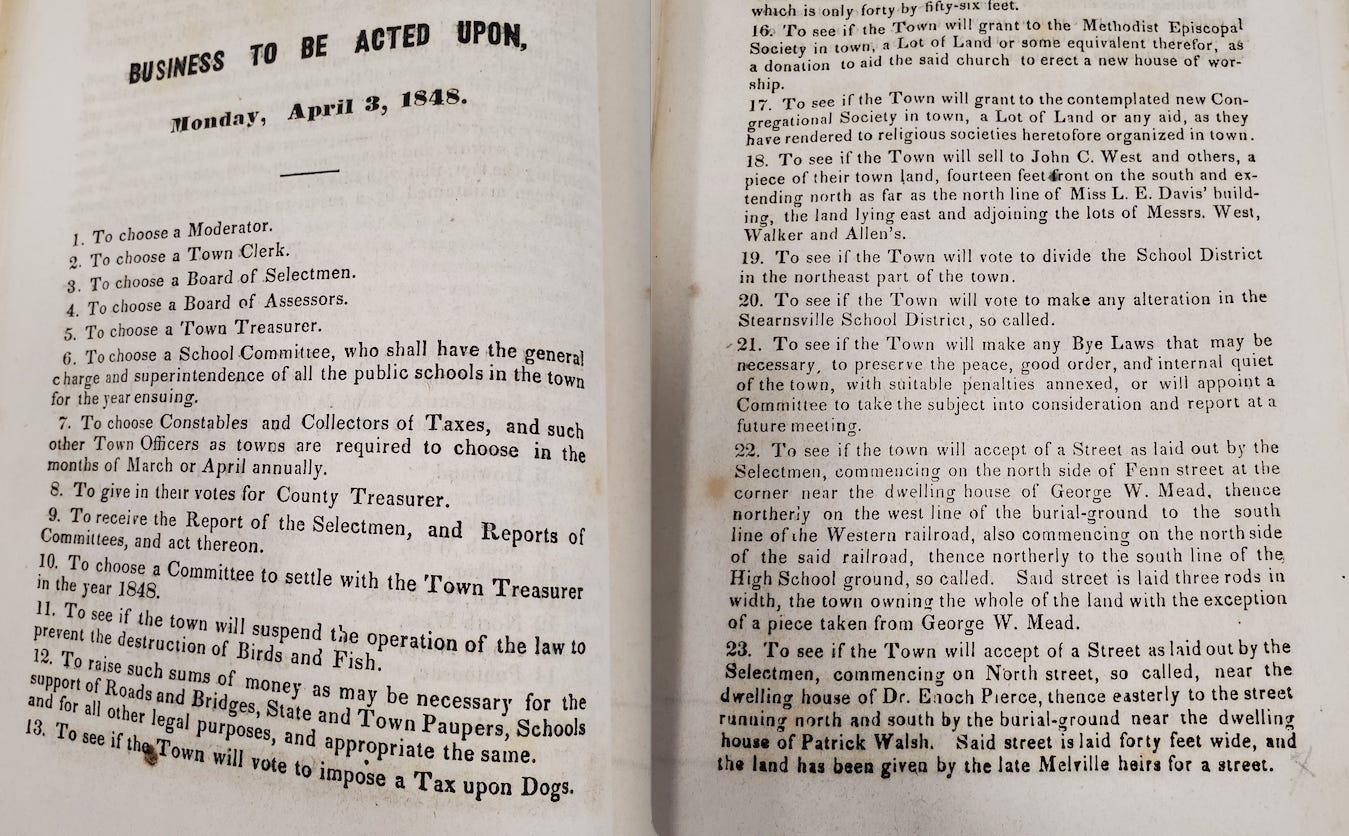
The item in question is #23, “To see if the Town will accept of a Street as laid out by the Selectmen… near the dwelling house of Dr. Enoch Pierce” on land given to the town “by the late Melville heirs.”
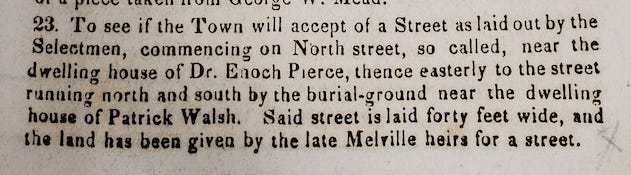
The picture was coming into focus, or we could at least start deducing a sequence of events. Thomas Jr. had apparently inherited the land when his father died in 1832. He, in turn, died in August 1845 and left the land to Robert. When the town needed a new street to connect North and First, the land was offered by Thomas’ children and named as such either as a tribute to their father or simply because that’s just who donated the land. It was the Melvills’ land so it became Melvill(e) Street.
This wasn’t even the only land given to the city after Thomas’ death. David also sent over a photo of a deed transfer written by the executors of his will which gave Pittsfield an additional six acres of land in the same area. My takeaway is that Robert had one foot out of Pittsfield’s door, running the manor as a boarding house for some cash flow as he quietly settled his father’s affairs in the town. Thus, when he finally sold the last of the property to the Morewoods in 1850, he was free to join his family on the frontier where he stayed until his death in 1881.
Stowing Down and Clearing Up
As for the spelling of the name, this too was resolved to some degree by David’s sleuthing—specifically, his discovery of the earliest map on which the street appears, dated 1849, which spells it correctly as “Melvill.”
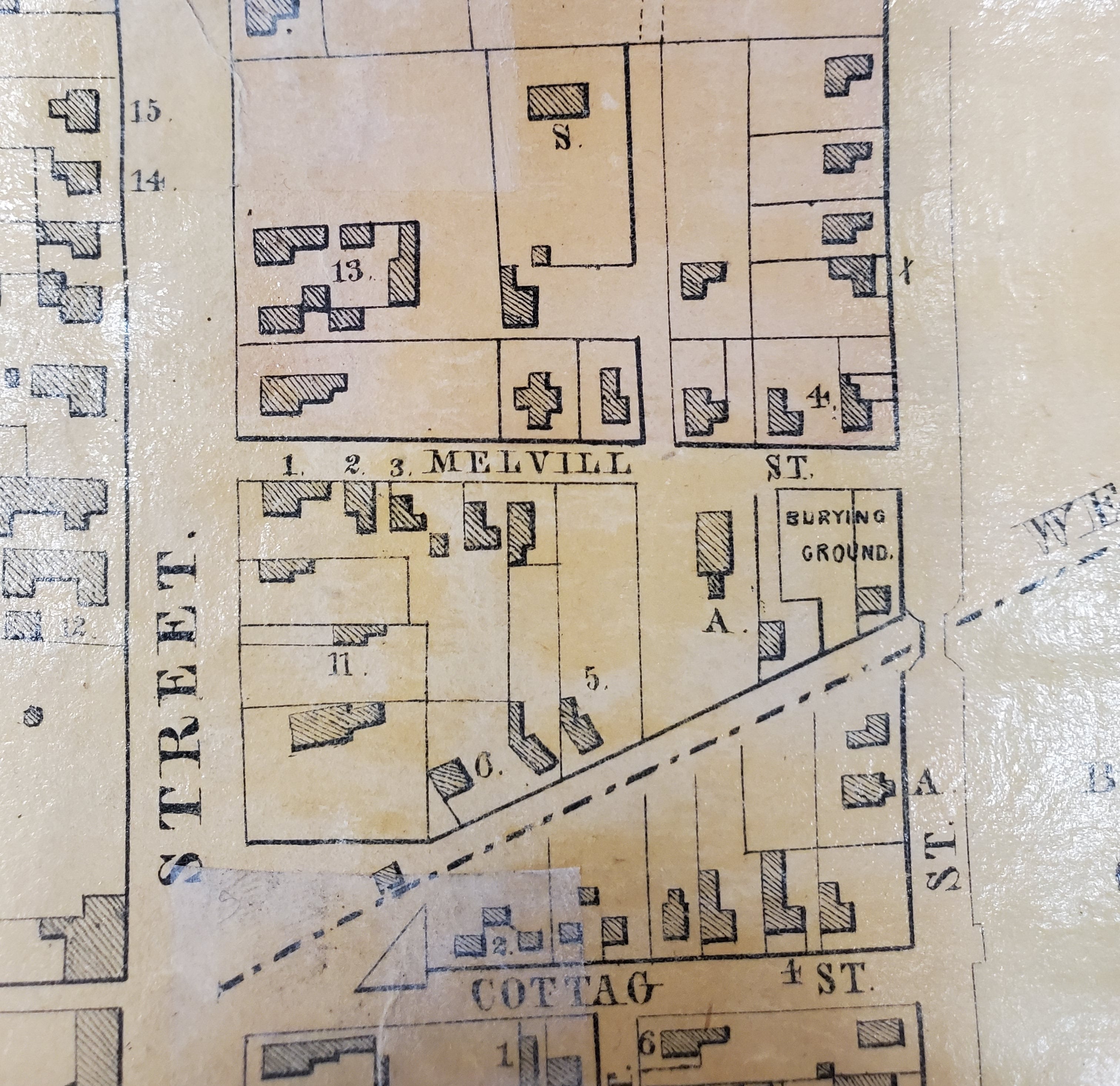
But as we’ve seen there was a immediate tendency to add the -e to the name, present even in the town minutes as it accepted the land from Thomas’ heirs. One possibility is that by the late 1840s Herman had already become the best-known member of the family with the success of Typee and Omoo. In fact, when Longfellow and his wife Frances stayed at Robert’s boarding house in the summer of 1848, Frances addressed a letter from “Melville Hall, Typee Valley,” adding: “It is very spacious and comfortable, and very well kept by Typee’s cousin.”
Incidentally, the minutes for that April 1848 town meeting also identified the Dr Pierce who originally owned the condemned house which started this investigation. He was Dr. Enoch Pierce (1791-1853), indeed a Pittsfield physician.
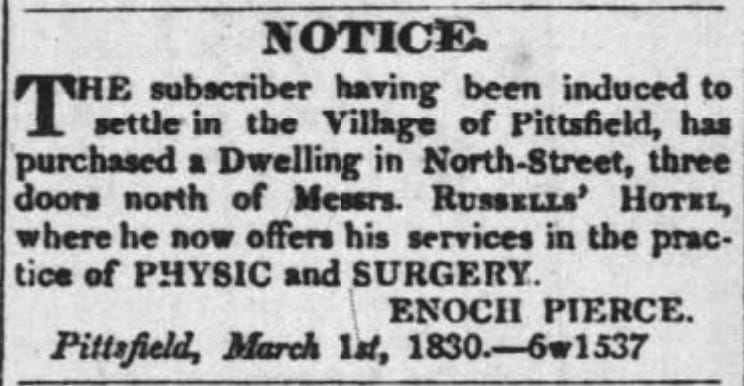
Enoch’s son, who was said to have “laid out Melville street” and named it for Herman, was thus David S. Pierce (often spelled Peirce) of Albany. David, born in August 1825, was a painter who attended nearby Williams College. But while he did earn the briefest of listings in Jacobsen’s Biographical Index of American Artists, I couldn’t find any meaningful information at all about his life or his interest in Melville. Thus, David’s connection to Melville Street, established when he was in his early 20s, remains a mystery.
“From hell’s heart I stab at thee”
On the other hand, maybe it’s for the best that Herman has as little as possible to do with Melville Street. Aside from the Halloween ghost parties and gridlock traffic, the street has a long reputation as an unsavory and frankly dangerous place.
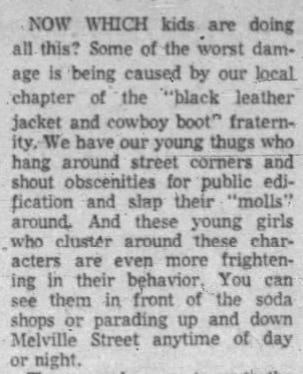
As far back as the 1950s, the Berkshire Eagle reported on “young thugs” in black leather jackets hanging around Melville Street, shouting obscenities and beating up their “molls” (girlfriends) day and night.
In the 1990s, a sports bar at 19 Melville St. was busted for allowing open sales of drugs. The district attorney sought the maximum punishment of suspending its liquor license for an entire year due to how many after-school programs surrounded the bar.
The street’s reputation has only gotten worse in recent decades. Go ahead and search for it and you’ll find stabbing after stabbing after stabbing. It’s stab city over there! On June 15th this year police responded to yet another stabbing on Melville Street.
Despite these violent attackers’ persistent (if unorthodox) literary allusion to Ahab’s last words, perhaps it’s best if we don’t petition the city to rededicate the street to Herman Melville. In fact, maybe we should instead nudge them to take a knife to the street sign and slice off that final -e.
This nice article reminded me of something I had long forgotten: that I once lived on 'Melville Walk' a (short) street in Hingham, Ma. The house (long ago demolished and a McMansion now sites on that lot) had been built in the 1870s shortly after the creation of Melville Gardens (https://www.patriotledger.com/story/lifestyle/2022/08/22/20-acres-pleasaunce-look-hinghams-melville-garden/10201235002/), a Victorian amusement park nearby. Melville Walk itself seems to have disappeared, although maps.google.com will still show a pin where it originated at Downer Ave. Whether or not any of this is related to Herman Melville, I do not know, and I'm sure you are tired of tracking down the history of streets named 'Melville', but I thought you could add this to your side file of things that might bear investigating at a later time...