
Whale Songs
; or, a 20th century musical homage to Melville

Once again, it’s time to clear out some old bookmarks and notes-to-self about the wacky world of Moby-Dick in the 20th century, if only to buy myself a bit more time as I wrap up a more intensive investigation on another topic completely.
We’ve previously looked at Moby-Dick tributes in art, illustration, philosophy, comedy, restaurants and bars, game shows, coffee, more coffee, cartoons and even serial killers. Today, we’ll sort through some leftover links all having to do with music. There’s no particular through line or narrative, just a collection of curios I wanted to share but which couldn’t sustain much of a deep investigation. I’ve got a real interesting one coming soon but, for now, headphones on! 🎧
Led Zeppelin’s song “Moby Dick” may not be the song for which the pioneering English rock band is best remembered, but it may be the most emblematic of the almost unfathomable excess of 1970s that defined and eventually destroyed the group. Released on their October 1969 album Led Zeppelin II, the song was intentionally crafted to be a showcase for drummer John Bonham’s unbridled talent and energy.
The instrumental song, as recorded, is essentially a three-minute long drum solo bookended by a blues-rock riff pilfered from Bobby Parker’s “Watch Your Step.” The Beatles actually had the same idea a few years earlier with their own Parker sound-alike “Day Tripper,” though John and Paul sure as hell weren’t going to let Ringo enter a drum fugue state for 90 percent of the length of the song.
The album version is only the beginning of the story, though, and the arc of “Moby Dick” tracks closely with that of the band’s original run as live performers. For much of their touring career in the 1970s, writes Stephen Davis in the Zeppelin 1985 bio Hammer of the Gods, “Stairway to Heaven” may have been the crowd’s favorite song but “Moby Dick” was the one that consistently drew the loudest cheers from fans. Over the years—and encouraged, enlivened, enraged by a particular white substance—the drum solo grew longer and longer, extending to 15, 20, even 30 (!) minutes straight while the other three members of the band went back to the green room to hang out and do more drugs. Meanwhile, Bonham held down the stage working in more and more sly percussive references to his favorite drummers and inspirations. If his sticks snapped in half he’d use his hands or his entire body, eliciting ravenous applause.
The most classic performance of the song was undoubtedly at Zeppelin’s concert at the Royal Albert Hall in 1970, one of surprisingly few in their career to be professionally recorded. Here, the solo was kept to a modest 13 ½ minutes before Jimmy Page and bassist John Paul Jones returned to the stage.
Of course, the drum schtick (ba-dum-tss) eventually grew old. Audiences took advantage of the self-indulgence as an unofficial halftime act and left to go to the bathroom or refresh their drinks. By 1977 the grumblings had grown to the point that the song was taken out of the set, reflecting a shift in musical preferences for shorter, simpler songs that would lead to an explosion of pop music in the 1980s. To this day, though, “Moby Dick” is considered one of the greatest drum tracks of all time and a benchmark for the pros. Just last year drummer Cotter Ellis of the jam band Goose made headlines for his practically note-for-note tribute to Bonham’s masterclass.
All that said, I’ve always wondered why Led Zeppelin named the song “Moby Dick,” and after just a little digging the answer was simple enough. Originally titled “Pat’s Delight” in honor of Bonham’s wife, somewhere along the process of rehearsals and recording it was allegedly changed following a comment from Bonham’s young son Jason. Per C.M. Kushin’s biography Beast: John Bonham and the Rise of Led Zeppelin, after one rehearsal Jason sang out: “‘It’s big like Moby!’, referencing “one of his favorite bedtime stories.”
I’ll leave it to readers as to how credible this story seems. I’m not going to die on this hill, but the album version of the song was recorded from May to June 1969, pieced together from multiple sessions. Jason, born in July 1966, would have thus been not even three years old when he is supposed to have made this abstract connection between some version of Moby-Dick and his father’s drum solo. It’s a little suspect.
For what it’s worth, the track preceding it on Led Zeppelin II, “Ramble On,” also had a literary connection, taking some weird inspiration from The Lord of the Rings.
'Twas in the darkest depths of Mordor
I met a girl so fair
But Gollum and the evil one
Crept up and slipped away with her, her, her, her, her, yeah
It’s also worth mentioning that the band were all big fans of the San Francisco psychedelic rock band Moby Grape. When Jimmy Page first laid eyes on Robert Plant in 1968, Plant was performing with a band called Obs-Tweedle doing covers of Moby Grape songs. “Since I’ve Been Loving You” straight up rips off Moby Grape’s song “Never.” So perhaps it was this connection that led to the title or at least gave it some personal meaning? Moby Grape, by the way, took its name from the punchline to a viral 1960s joke: “What’s big and purple and lives in the ocean?” (I guess you had to be there.)
Anyway, John’s son Jason, who turns 60 this year, has for many years been the bandleader and drummer of the Zeppelin tribute act Jason Bonham’s Led Zeppelin Evening, playing “Moby Dick” regularly on their 2018 tour but only once since. As Jason alludes to in this video of one of the performances, his father performed the ferocious and exhausting solo live on tour while he was still a young man. Bonham was only 32 when he drank himself to death in 1980. In other words, it’s not surprising that Jason, now twice as old as his father ever was, seems to have put “Moby Dick” marathon performances behind him.
Speaking of all that, the band that would soon become Nirvana covered Led Zeppelin’s “Moby Dick” at one of their earliest ever gigs on January 23, 1988 at Tacoma’s Community World Theater. At the time, Kurt Cobain and Krist Novoselic were performing under the name Ted Ed Fred with drummer Dale Crover, better known for his career with The Melvins. Amazingly, the entire concert—the earliest surviving footage of the band—is available on YouTube, including “Moby Dick” which starts around 45 minutes in. That said, rather than a proper drum solo it’s more of an extended noise freakout session by all three members of the band.
Earlier that same day the trio had recorded its first official demo tape. Two of these songs were remixed and released Nirvana’s first album Bleach. Another five were released untouched on the band’s 1992 compilation album Incesticide. One has to wonder if “Moby Dick” (or Moby-Dick) had been on their minds in the studio that afternoon, though there’s nothing suggesting they tried to record it.
One last strange coincidence: it had been several months since the band’s last gig, also at the Community World Theater in Tacoma. That night the bill included the thrash/hardcore band Sons of Ishmael as one of the supporting acts—though the reference seems to be more Biblical than Melvillean. But if only to bring the whole thing full circle, at the time of the show Sons of Ishmael had recently released its album Pariah Martyr Demands a Sacrifice, which included a “Mystery Bonus Track” on the B-side: a “cover” (of sorts) of “Stairway to Heaven.”
On a totally different note, Moby Arena is an 8,000-seat arena on the campus of Colorado State University in Fort Collins. The arena is primarily the home of the school’s Rams basketball team but has hosted fairly sizable—if especially dad-rock oriented—concerts over the years, including the Rolling Stones, Frank Zappa, Steve Miller Band, the Doobie Brothers, Chicago, and Van Halen.
So why is it called Moby Arena? Well, just take a look.
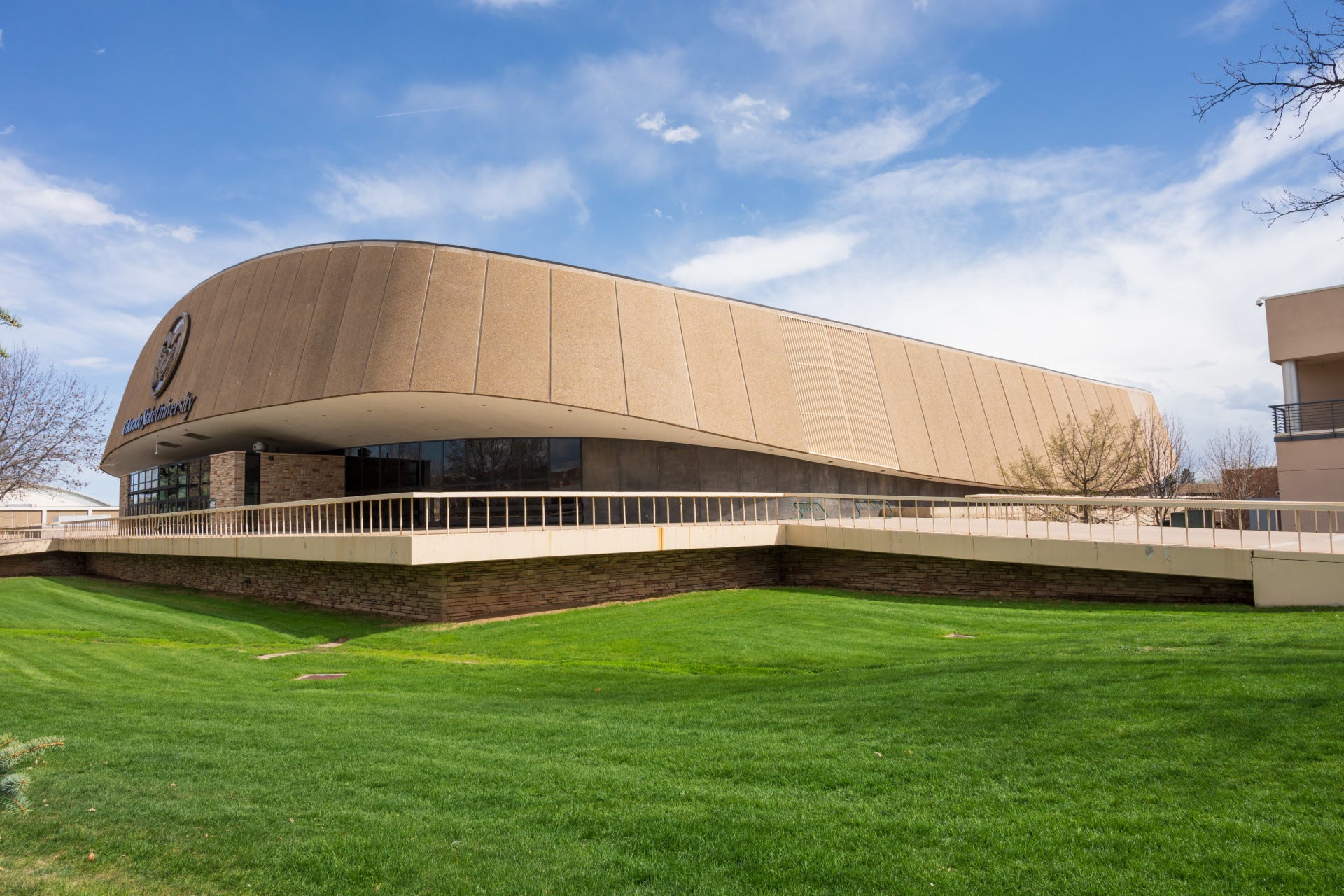
It’s not just a nickname either—at least not since Van Halen was still topping the charts. Ahead of its grand opening in January 1966, sports editor of the school newspaper Steve Kewskin solicited ideas for a name from students, most of which poked fun at its unusual shape: “Giant Mushroom,” “Great Arch,” “The Saddle,” “Pumpkin Palace,” and one that caught Kewskin’s eye: “White Whale.”
With a writerly instinct, Kewskin simplified the idea to Moby Gym and began using it in all of his articles in the Rocky Mountain Collegian paper going forward. For obvious reasons, the student body also quickly adopted the name and by 1988 the school’s athletic director made it official. It would henceforth be known as Moby Arena.
While I admit Moby Arena isn’t primarily a concert venue (I mostly just wanted to share that amazing photo), it has hosted performances in acts in a variety of genres over the years including Steve Aoki, Ludacris, Yellowcard, And You Will Know Us By the Trail of Dead, Gov’t Mule, O.A.R., 311, and Hoobastank.
It has not, so far as I can tell, hosted Moby.
Frankie Laine was a singer, songwriter, and actor whose career spanned practically the entirety of the 20th century, beginning his career as an entertainer at 1930s dance marathon contests (like the one at the center of the 1969 Sydney Pollack film They Shoot Horses, Don’t They?) and last performing in 2005 two years before his death at the age of 93.
Laine sang in a variety of styles but certainly his legacy is having recorded the theme song to a number of classic westerns including Gunfight at the O.K. Corral, 3:10 to Yuma, Blazing Saddles, and even the TV show “Rawhide” (“Rollin’ rollin’ rollin…’”). And while it’s neither here nor there, I can’t fail to mention that Laine’s nicknames included “Old Leather Lungs” and “Mr. Steel Tonsils,” both of which are apparently compliments and not medical conditions.
Somewhere along that old dusty trail Laine was convinced to record a song written by Sid Prosen as an unofficial tie-in for the upcoming John Huston/Gregory Peck Moby-Dick film, riding the whale’s flukes as it were. Released in April 1956, the track is squarely in the genre of 50s novelty songs—maybe even children’s music, though it’s sometimes hard to tell the difference in that era—and, accordingly, it doesn’t take the story too seriously.
The lyrics go like this:
Yo-ho, yo-ho, a-whaling they did go
Oh Moby Dick was so big and slick, there was never such a whale
He’d sink a ship with the slightest slip with his mighty, mighty tail
Oh Moby was the toughest whale living in the seven seas
His breath was like an icy gale that could make a man’s blood freeze
‘Tis said this whale of purest white with a heart as black as coal
Was always in a mood to fight, the devil had his soul
Yo-ho, yo-ho, a-whaling they did go
The bravest men chased after him and each one of them he fought
And every ship he did outswim, til this day he’s not been caught
They couldn’t pierce his hide of steel, no harpoon made would hold
But take my word that he was real as the stories that I’ve told
Yo-ho, yo-ho, a-whaling they did go
The captain would not heed the mate, the crew was tired and worn
No sailing man should fight his fate for a whale so scarred and torn
This kind of man won’t be denied what’s on the briny deep,
And that is why the captain died way out where he lies asea
Close enough, I guess.
The B-side to “Moby Dick” was another seafaring song called “A Capital Ship,” which one review called “a sort of nautical nonsense song” and complained that its lyrics were even worse than the title track. Shockingly, the 45 failed even to become a kitsch hit and did not merit a mention in his autobiography.
Avoiding the problem of lyrics altogether was the British alto saxophonist and big band leader Johnny Dankworth, one of the “totemic figures of British jazz” in the mid-20th century and considered the UK’s “first major jazz musician.” I’ll be honest, I’d never heard of him before this but I do love the name. Officially, he was the much more British-sounding John Phillip William Dankworth and was even knighted in 2006, so make that Sir Dankworth to you.
Like Frankie Laine, Dankworth was inspired by the 1956 film and titled a track off his May 1956 album Memories of You as a tribute—to cross-promotion, anyway. Listen and you may note that the two minute instrumental song makes not even the slightest nod toward a nautical motif or anything else that might connect it to the title.
Dankworth actually dipped into literature for musical inspiration on a number of occasions. Among his many, many recordings are albums like Shakespeare and All That Jazz, Windmill Tilter (The Story Of Don Quixote), and What the Dickens?, a thematic tribute to some of the author’s most notable books and characters. He was also commissioned to write a piece for the 1967 Farnham Festival in Surrey, England, composing music for the first chapter of The Adventures of Tom Sawyer in the style of “Peter and the Wolf” meant to be playable by youth orchestras.
Despite all of this literary name dropping, though, Dankworth once said that “Dickens is the only author I’ve ever really read,” which I suspect is kind of like saying that Melville is the only author I’ve ever really read: not literally true, but extremely true on a certain level.
Rereading MDick again and finding it quite funny. This article helps.
Another great article that enlivened my morning! Good excuse to put on some Led Zeppelin